Main Menu

About Us
Latest News
.png)
.png)
Not Available previous
Not Available next
AI Infrastructure Economics: Why GPUs and Data Centres Are the Real Bottleneck
04.02.2026
· AI is constrained by infrastructure, not innovation
· GPUs and data centres are emerging as an alternative asset class
· Investors are shifting from AI vendors to physical infrastructure
· Scarcity and utilisation are shaping long-term returns
· Execution now matters more than novelty
Artificial intelligence (AI) is often discussed through thelens of software innovation. New foundation models, faster iteration cycles andexpanding use cases continue to dominate global headlines andequity market narratives. Yet beneath those conversations sits a more decisiveconstraint: the physical infrastructure required to run AI at scale.
As AI adoption accelerates across industries, long-term outcomes are increasingly shaped less by incremental algorithmic advances and more by access to computing power, GPUs and data centre capacity.
In this context, AI infrastructure is becoming a core focus for institutional investors, and our recent research shows that this shift is already underway. Shows that this shift is already underway.
From AI innovation to AI infrastructure
Every large-scale AI system relies on a complex physical stack. Beneath the software layer are high-performance GPUs, data centres built for sustained use, dependable power, advanced cooling and connectivity.
While demand for AI continues to grow rapidly, the ability to supply infrastructure remains constrained by factors that are structural rather than cyclical. Semiconductor manufacturing capacity, grid access, land availability, planning regulation and environmental considerations - all limit how quickly new infrastructure can be delivered.
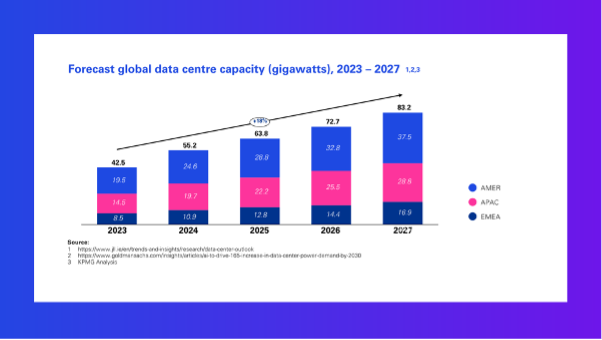
According to the House of Commons Library, global data centre capacity is expected to grow by around 15% per year to 2027. That rate of expansion falls materially short ofAI-driven demand growth, particularly as generative AI and inference workloads scale across sectors.
This mismatch reflects the many challenges that the required land development and regulatory complexities present to AI opportunity. As a result, AI infrastructure is beginning to exhibit economics and characteristics more commonly associated with traditional infrastructure assets than with short-cycle technology investments. It is accepted that these assets are expensive to build, slow to deploy and often bespoke, which means that returns for investors depend less on being the first to adopt new technologies and more on the development of high-quality infrastructure overtime.
Key Findings from Nuway Capital and KPMG’s Research
GPUs and data centre infrastructure as an emerging alternative investment category, shaped by both supply limitations and technological demand.
Several characteristics stand out:
· Sustained demand as AI workloads become embedded in core business processes
· High barriers to entry driven by capital intensity and power constraints
· Operational sensitivity, with returns influenced by asset selection, efficiency and utilisation discipline
· Longevity, particularly for well-located and appropriately specified assets
These dynamics are already influencing investor behaviour. Our survey data shows that GPUs are now viewed as more attractive investment opportunities than other emerging technologies, with over 70% of high-net-worth investors and 60% of family offices and wealth managers ranking GPUs ahead of blockchain, quantum computing and renewable energy.

Nearly 80% of respondents also identified generative AI as the primary driver of their interest in GPU investing, reinforcing the shift away from speculative technology exposure and toward the physical infrastructure underpinning AI at scale.
Crucially, this points to a shift in focus away from individual AI vendors and toward the physical infrastructure required to scale AI reliably and sustainably.
Why utilisation and asset selection now matter more
As AI infrastructure matures, returns are determined by execution rather than innovation alone.
KPMG’s analysis in the white paper suggests that AI demand is increasingly driven by scalable, repeatable workloads rather than experimental use cases. This places greater emphasis on infrastructure fundamentals.
For investors, system selection, power strategy, location and operating efficiency are now central to performance. Hardware deployed early in its lifecycle and aligned with widely used workloads tends to deliver more stable utilisation and more predictable long-term returns.
Access models and recurring demand
High capital costs and supply bottlenecks are also reshaping how organisations access computing capacity.
Nuway Capital’s research with KMPG highlights growing investor interest in GPU-as-a-Service models, with more than 75% of surveyed investors viewing them as either promising or highly innovative. These structures allow users to access high-performance computing without owning hardware, while offering investors exposure to recurring, usage-linked revenues.
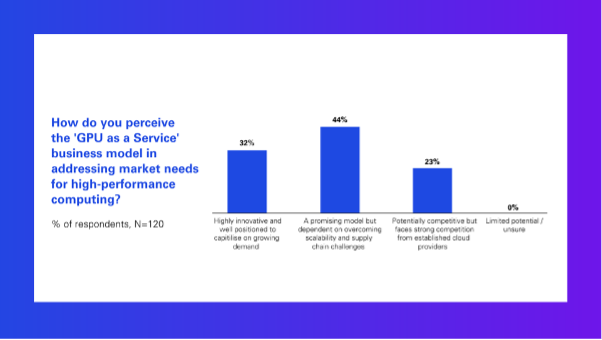
Within an infrastructure framework, these models combine scarcity dynamics with long-term demand visibility, reinforcing the asset-like characteristics of AI compute capacity.
Nuway Capital’s perspective on AI infrastructure investing
At Nuway Capital, we approach AI through an infrastructure lens rather than a technology hype cycle.
Our focus is on access to GPU capacity, data centre infrastructure and related platforms that prioritise utilisation, asset quality and disciplined execution. We take an end-to-end view of the AI value chain considering power sourcing, location and workload alignment alongside hardware deployment.
As AI becomes more deeply embedded in the global economy its foundations are becoming more measurable, more investable and more central to long-term value creation.
------
To explore the full findings and data underpinning this analysis, access the Nuway Capital & KPMG “Investing inGPUs – Paper II” research.
This article draws on joint research by KPMG and Nuway Capital and does not constitute investment advice.


.png)